Your resource for Stratum-1 GNSS and GPS NTP Servers, Master Clocks and Network Time Servers for precise network time synchronization.
Our PoE enabled NTP synchronized network clocks and time displays provide organization-wide access to a legally traceable time reference.
GPS Time Servers
T100 Compact GPS NTP Time Server
TimeTools T100 time server is a very cost-effective, accurate, Stratum-1 GPS referenced Network Time Protocol Server in a compact enclosure. It provides an accurate time reference to computer networks and can accurately synchronize any NTP or SNTP compatible system. Find out more about TimeTools T100 GPS NTP Time Server.
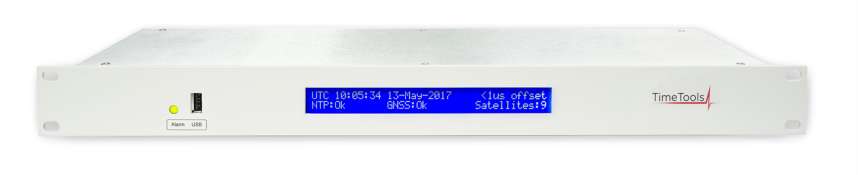
T300 1U Rackmount GPS NTP Server
TimeTools T300 T550 are 1U high rack-mountable Linux-based true stratum 1 NTP Network Time Servers that offer a real breakthrough in price and performance.
The T300 is a NTPv4 Stratum-1 GPS-referenced Network Time Server appliance featuring a high-sensitivity GPS receiver that can synchronize to within 15 nanoseconds of UTC time. Find out more about TimeTools T300 GPS NTP Server.
Multi-GNSS NTP Servers
Multi-GNSS NTP servers can operate from multiple satellite systems, providing improvements in both reliability and redundancy. In addition to GPS, the US based Global Positioning System, multi-GNSS NTP servers can also concurrently operate with Galileo, GLONASS and BeiDou satellite systems.
T550 1U Rackmount Multi-GNSS NTP Time Server
The T550 is a Multi-GNSS referenced Stratum-1 NTP Time Server that can concurrently receive GPS and either GLONASS, BeiDou or Galileo. It also features dual Ethernet ports and a high-stability TCXO oscillator. Find out more about TimeTools T550 Multi-GNSS NTP Server.
NTP Network Clocks

TimeTools Ethernet NTP synchronized PoE digital and analog IP wall clocks provide an accurate synchronized time display throughout any organization. The wall clocks accurately synchronize time to a Master Clock using SNTP over IP on an Ethernet network. Find out more about NTP Synchronized IP Network Clock Products.
NTP Clocks
NTP clocks synchronize using the Network Time Protocol (NTP) over an Ethernet network to provide an consistently accurate time display. The clocks can obtain time from an internet based or local NTP server or NTP master clock. Additionally, the SNTP protocol can also be used. Network clocks are entirely maintenance-free, daylight saving changes are completely automatic. Find out more about NTP clocks.
IP Clocks
IP clocks synchronize to a local master clock or internet time server using the NTP or SNTP protocol over an Ethernet IP network. The clocks synchronize automatically, are maintenance free and, once configured, require no operator intervention. Additionally, time zone and daylight saving changes are configurable and are enacted entirely automatically. Find out more about IP clocks.
PoE Clocks
Power-over-Ethernet (PoE) allows both data and power to be provided over a single CAT5 or better network cable. PoE clocks can be powered from the network cable without the need for a separate power supply or electrical socket near the clocks location. Additionally, TimeTools clocks comply with industry standard IEEE 802.3af PoE. They can be installed on existing networks with the simple addition of a PoE injector. Find out more about PoE clocks.
Master Clocks
A master clock maintains accurate time from an external reference and provides synchronization signals to slave clocks on a network. TimeTools NTP master clocks synchronize slave clocks using the NTP protocol over an Ethernet network. The T-Series NTP master clock appliances reference satellite systems such as GPS, GLONASS, Galileo or BeiDou for very precise timing information. Find out more about master clocks.
Slave Clocks
TimeTools slave clocks provide an organization-wide accurate display of time. Each clock synchronizes to a NTP server, master clock or internet time server using the Network Time Protocol. Each slave clock can be individually configured for a specific time zone and daylight saving time. The clocks require no operator intervention and are maintenance-free. Any daylight saving time changes are completely autonomous. Find out more about slave clocks.
Customer References and Testimonials
A large number of prestigious organisations from around the world trust TimeTools for their synchronization requirements. Here is a small selection:

“Just installed our first TimeTools NTP Server. We were quite surprised about the craftsmanship and quality of the product… Thank You very much.”
Strüby Konzept AG, Sweden
TimeTools is an ISO 9001 Accredited Company.
ISO 9001 is an internationally recognised standard for quality management. It specifies the requirements to successfully implement a Quality Management System in order to monitor and improve the performance of a company.

ISO 9001 accreditation demonstrates that quality assurance and customer satisfaction is of paramount importance to us.